
SEO

Search traffic matters when it reaches people who may need your services. We review how your website is discovered, understood and used, then connect the findings to the pages and enquiries that matter to your business. A high tool score is not a substitute for a useful website.
Your proposal identifies the work in scope, the pages or accounts involved and who is responsible for each approval.
Review crawl access, indexing signals, canonicals, redirects, internal links and important page templates. Each finding should identify the affected URLs and explain why the issue deserves attention.
Map relevant customer questions to appropriate pages. Review whether the content answers those questions, explains the offer clearly and helps a visitor decide what to do next.
Improve titles, descriptions, headings and contextual links where the evidence supports a change. Avoid repeating keywords at the expense of useful explanations.
Agree the reporting baseline and the pages in scope. Separate completed work from changes in visibility, traffic and qualified enquiries.
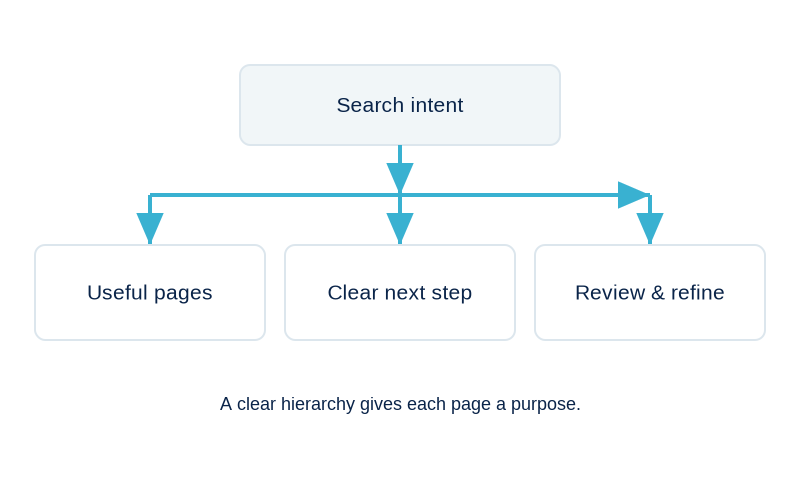
Imagine a service page appearing for relevant searches but attracting few useful enquiries. The next step is to understand the gap. We would compare the search terms with the page’s offer, check how the page is linked internally and review whether a visitor can find the information needed to make a decision.
A vague service description, an unclear location or a difficult contact route may need attention before another article is published. Equally, a technical issue might prevent an important page from being selected or understood. The recommendation should identify the actual problem rather than assume every weak result needs more content.
For an initial review, useful context includes your priority services, the locations you serve, recent website changes and any reliable reporting already available. Where access is missing, findings should state what could not be checked. A limited review should not be presented as a complete diagnosis.
This is an illustrative decision process, not a claim about a particular client. The final work depends on the evidence collected from your own website.
✓ A prioritised findings list with affected page URLs
✓ A defined implementation scope and approval points
✓ A record of completed changes and relevant checks
✓ A progress review with context and recommended next steps
Suitable for service websites, content-led businesses and organisations that need clearer priorities before committing to ongoing SEO. A focused technical review can be scoped separately from implementation.
Understand priority pages, search queries and available evidence.
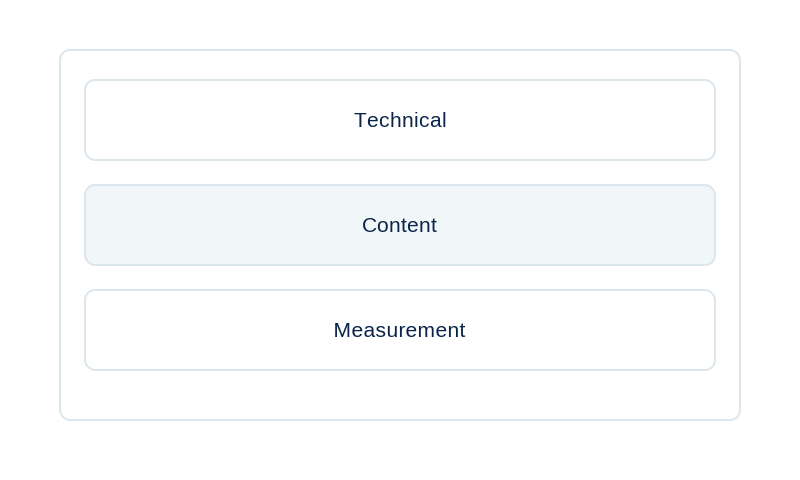
Separate technical, content and on-page issues into a practical action list.
Work on agreed changes and record the pages affected.
Review completed work and available search and enquiry data in context.
Where access and reliable tracking are available, reporting can cover Search Console impressions and clicks, relevant landing-page performance and tracked enquiries. Seasonality, platform changes and tracking gaps need context. We do not promise a particular ranking or traffic increase.
See an anonymised project review for an example of how we distinguish recorded activity from outcomes.
A useful findings report explains the affected page, the observation and the recommended action. It should also identify dependencies: for example, whether a developer must alter a template or whether a business owner needs to confirm service details before copy is changed.
Priority depends on relevance to your goals, the strength of the evidence and the effort involved. A technically valid recommendation may still be low priority if it affects an unimportant part of the website. We discuss those trade-offs before expanding the scope.
After implementation, checks should confirm that the intended change is present and that important functionality still works. Search performance needs a separate review over a suitable period. Completing a task and observing a business outcome are related, but they are not the same measure.
Your review should leave you with a clear next decision: continue the current work, investigate an unresolved question or revise the priorities. It should not leave you with a long list of unexplained tool warnings.
There is no single timetable. Website condition, scope, competition and implementation speed affect the work. We agree delivery milestones for the tasks; search-engine responses remain outside our control.
No. We can carry out and document agreed improvements, but search engines determine rankings. A proposal should explain the work and how progress will be assessed.
Depending on scope, read access to Search Console and analytics may be enough for an initial review. Publishing changes requires appropriate website access, arranged securely.
Yes, the scope can separate recommendations from implementation. The report should explain affected pages, the proposed change and the evidence needed to verify the work.
Not necessarily. Recommendations should be prioritised against your goals, constraints and available evidence. The agreed scope identifies which changes are included.
Tell us what you want to improve. We can discuss a practical starting point, the evidence needed and a scope you can review before committing.
Tell us about your project
Complete the form below. Fields marked * are required.