
SaaS Link Building Case Study
Anonymised case study · SaaS & software
Link-building activity with a clear reporting trail.
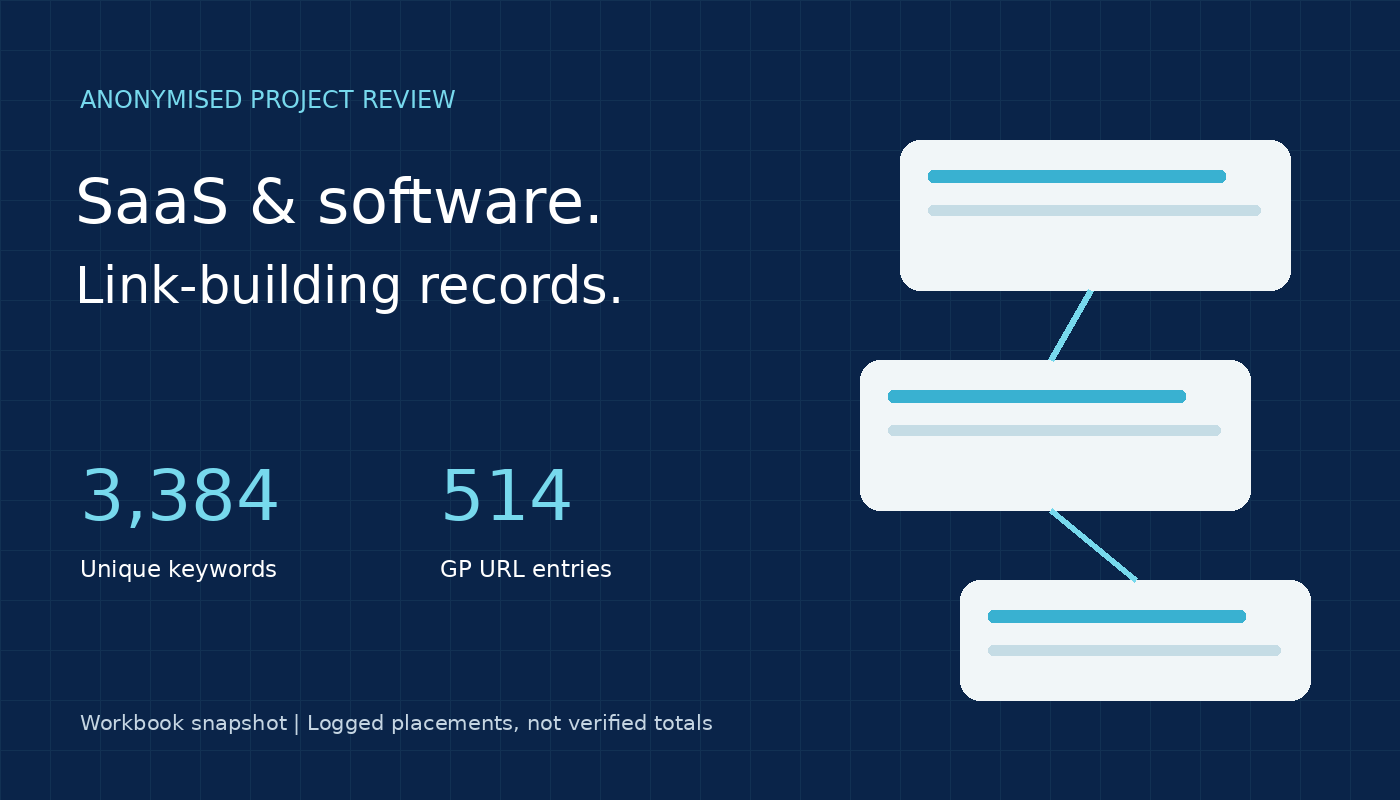
A software-focused project workbook combining content placements, paid-placement records, profiles, listings and search visibility. Client names, domains, publisher URLs, personal contacts and source files are withheld.
The project context
The workbook covers software-related content, including healthcare systems and business applications. Its link-building records are organised into separate tabs for article placements, paid activity, profiles, directory listings and blog distribution. Search visibility is documented in a separate keyword export.
This review focuses on the recorded activity and the visibility snapshot. It does not attribute rankings or traffic to an individual placement, and it does not present every logged URL as a verified editorial backlink.
How the activity was documented
Placement tracking
The GP tab records publisher information, destination URLs and anchor text, with authority and spam metrics for some entries. These third-party metrics do not establish the quality or impact of a particular link.
Status management
The paid tab distinguishes live, unavailable and unlabelled records. It also separates guest-post and link-insertion activity. A spreadsheet status is a reported state, not a current independent link check.
Search visibility
The keyword export includes recorded position, previous position, volume and mapped pages. Duplicate keyword phrases occur, so unique phrases and keyword–page records are counted separately.
Recorded placement inventory
| Workbook category | URL entries | Unique URLs within the tab |
|---|---|---|
| GP tracker | 514 | 514 |
| Paid placements | 32 | 29 |
| Profiles | 43 | 43 |
| Listings | 24 | 24 |
| Blog distribution | 37 | 37 |
Counts include rows containing an HTTP or HTTPS URL in each tab’s placement field. Tabs are not deduplicated against one another. These figures are an inventory of records, not a total of verified, indexed or followed backlinks.
Of the 32 URL entries in the paid tab, 26 are marked “Live”, two are marked “Not”, and four have no status. Three URL entries repeat an existing URL. No assumption is made about the current availability or link attributes of those pages.
The keyword snapshot
The main export contains 3,771 keyword records representing 3,384 unique keyword phrases. Of those records, 40 have a position between 1 and 3, 334 between 1 and 10, and 1,088 between 1 and 20. These ranges overlap: the top-10 count includes the top-three records.
40
294
754
2,683
Distribution counts records, not unique phrases. Product and client names are omitted.
What can be concluded
The workbook provides a substantial activity log and a way to review recorded search visibility alongside different placement categories. It also shows why separate status fields and duplicate checks matter: a row with a URL is not the same as a confirmed live backlink.
The main keyword export does not show recorded position improvements against its previous-position field: five records have worse positions and the remaining records are unchanged. It does not establish a consistent reporting period, a campaign-wide traffic increase or additional leads and revenue. No growth percentage, return on investment or causal link-building result is claimed.
Some activity records carry dates from July 2026 onward, while others are undated. A reliable campaign timeline would require consistent dated reports and independent checks of placement availability, indexing and link attributes.
Make link-building reporting easier to evaluate.
Discuss a scope that distinguishes outreach activity, confirmed placements and measurable search outcomes.